26 September, 2026
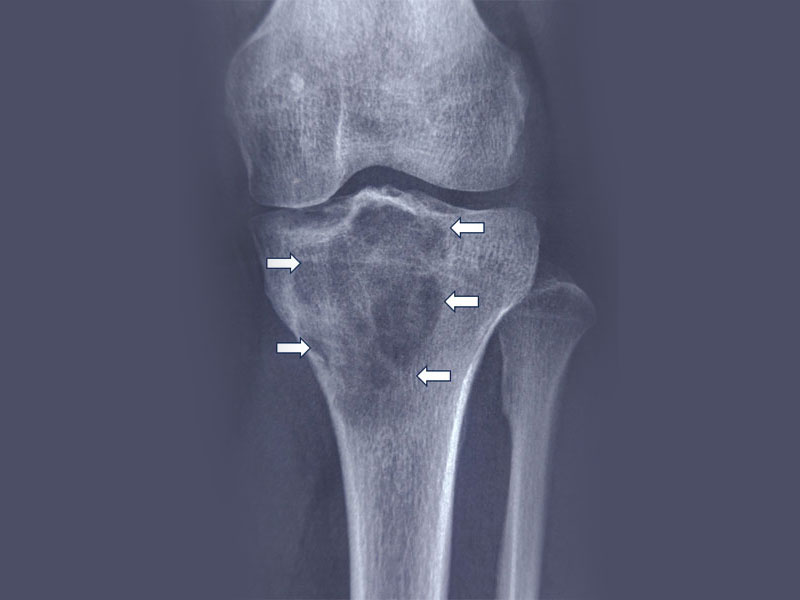
A diagnosis of Giant Cell Tumor of Bone (GCTB) can be confusing and concerning for patients. Despite the word “tumor,” GCTB is generally considered a benign but locally aggressive bone tumor. It usually occurs in young adults and most commonly develops near the end of a long bone, particularly around the knee.
GCTB can cause significant destruction of bone and, in rare cases, can spread to the lungs. This is why an accurate diagnosis and appropriate treatment planning are important.
What Is Giant Cell Tumor of Bone?
Giant Cell Tumor of Bone, also called osteoclastoma, is a primary bone tumor that typically develops in skeletally mature individuals.
It most commonly occurs at the end of a long bone close to a joint, with the area around the knee being the most frequent location. The distal femur and proximal tibia are particularly common sites. Other locations include the distal radius, proximal humerus, pelvis and sacrum.
The tumor contains numerous multinucleated, osteoclast-like giant cells. These cells contribute to bone destruction, which explains why GCTB can progressively weaken the affected bone.
Although traditionally described as a benign tumor, its behavior can be locally aggressive. The World Health Organization classification recognizes GCTB as an intermediate tumor because of its locally destructive nature and low but real potential for metastasis.
Is Giant Cell Tumor of Bone Cancer?
Usually, no.
Most GCTBs are not classified as conventional malignant bone cancers. However, they can behave aggressively and destroy the surrounding bone and soft tissues.
Rarely, GCTB can:
- Recur after treatment
- Spread to the lungs
- Undergo malignant transformation
Pulmonary metastases are uncommon and are generally considered a rare complication of GCTB.
Therefore, although GCTB is generally benign, it should not simply be considered an insignificant bone lesion.
Who Is at Risk of Developing GCTB?
GCTB most commonly affects young and middle-aged adults, particularly those between approximately 20 and 40 years of age. It is uncommon in children because the tumor usually develops after the growth plates have closed.
In most patients, there is no identifiable lifestyle or environmental cause. GCTB generally develops sporadically, meaning it is not something a person develops because of diet, exercise, injury or any specific behavior.
Where Does Giant Cell Tumor Usually Occur?
The most common location is around the knee.
Typical sites include:
- Distal femur – lower end of the thigh bone
- Proximal tibia – upper end of the shin bone
- Distal radius – lower end of the forearm bone near the wrist
- Proximal humerus – upper arm near the shoulder
- Proximal femur – near the hip
- Pelvis and sacrum
- Less commonly, the hands, feet or spine
Because GCTB often occurs close to a joint, symptoms may involve not only the bone but also the nearby joint.
What Are the Symptoms of Giant Cell Tumor of Bone?
The symptoms depend on the location and size of the tumor.
Bone Pain
Pain is the most common symptom.
It may initially be mild or intermittent and can gradually become more persistent as the tumor enlarges.
Pain around the knee, wrist, hip or shoulder may sometimes be mistaken for a routine joint or sports-related problem.
Swelling or a Lump
As the tumor grows and expands the bone, patients may notice swelling or a visible or palpable lump.
A soft-tissue swelling can occur when the tumor extends through the outer layer of bone into surrounding tissues.
Restricted Joint Movement
Because GCTB commonly develops close to a joint, patients may develop stiffness or reduced range of movement.
For example, a tumor around the knee may cause difficulty bending or straightening the knee.
Difficulty Bearing Weight
A large or structurally significant tumor can weaken the bone and make walking or weight-bearing painful or difficult.
Pathological Fracture
Sometimes the tumor weakens the bone so substantially that it fractures following relatively minor trauma. This is called a pathological fracture.
A fracture through a GCTB can make treatment more complicated and requires careful assessment of both the tumor and the surrounding joint and soft tissues.
Can Giant Cell Tumor Spread to the Lungs?
Rarely, yes.
Although GCTB is generally benign, pulmonary metastasis can occur in a small proportion of patients. The lungs are the most common site when distant spread occurs.
The risk appears to be associated with factors such as locally aggressive disease and recurrence.
This does not mean that every patient with GCTB will develop lung disease. However, appropriate evaluation and follow-up are important, particularly in patients with aggressive or recurrent tumors.
How Is GCTB Different From Other Bone Tumors?
Several bone tumors can produce pain, swelling and an abnormal X-ray or MRI appearance.
Depending on the patient’s age and the location of the lesion, conditions such as aneurysmal bone cyst, chondroblastoma, brown tumor and certain malignant bone tumors may need to be considered.
This is why a diagnosis should not be made simply from symptoms or from an isolated scan.
A combination of clinical assessment, X-rays, MRI and, when necessary, biopsy and pathological examination is used to establish the diagnosis.
Dr. Love Kapoor’s Perspective
Giant Cell Tumor of Bone is often described simply as a “benign tumor,” but this can underestimate its potential impact.
GCTB is a locally aggressive tumor that requires careful diagnosis and individualized treatment planning. The location of the tumor, extent of bone destruction, involvement of the nearby joint, soft-tissue extension and presence of a pathological fracture can all influence treatment decisions.
One of the important goals in treating GCTB around a major joint is to achieve appropriate tumor control while preserving the patient’s natural joint and limb function whenever it is safely possible.
The right treatment therefore begins with the right diagnosis and a careful assessment of the individual tumor.
Why Consult Dr. Love Kapoor for Giant Cell Tumor?
Being told that you have a Giant Cell Tumor of Bone can be worrying—especially when the tumor is close to an important joint such as the knee, wrist, hip, or shoulder. You may be wondering whether you need surgery, whether your joint can be preserved, and what your recovery will look like.
These decisions require more than simply removing the tumor. The treatment needs to be planned according to the location and extent of the tumor, the amount of bone destruction, involvement of the joint, soft-tissue extension, and presence or absence of a pathological fracture.
As an AIIMS-trained Orthopaedic Oncologist specializing in bone tumors and soft tissue sarcomas, Dr. Love Kapoor focuses specifically on the diagnosis and treatment of musculoskeletal tumors.
When you consult him for GCTB, the aim is to understand your individual tumor and choose a treatment that provides effective tumor control while preserving your natural joint and limb function whenever it is safely possible. Depending on your situation, this may involve joint-preserving surgery such as extended curettage and reconstruction, or more extensive surgery with reconstruction or a tumor prosthesis when required.
If you have recently been diagnosed with GCTB, have been advised surgery, or are looking for a second opinion, a specialist consultation can help you understand what your tumor means, what treatment options are available, and whether your natural joint can potentially be preserved.
This article is intended for general educational purposes and does not replace an individual medical consultation, examination, imaging review or pathology assessment.
Category:
Giant Cell Tumor of Bone
Tags:
Giant Cell Tumor of Bone
Giant Cell Tumor of Bone Cancer
Symptoms of Giant Cell Tumor of Bone
 +91 93558 33005