14 October, 2026
Being told that a Giant Cell Tumor of Bone (GCTB) has come back after surgery can be frightening.
You may immediately wonder:
- Does this mean I need a bigger operation?
- Will I need a joint replacement now?
- Can the tumor be removed again?
- Will I lose my limb?
The good news is that local recurrence does not automatically mean that the limb or joint has to be sacrificed.
Recurrent GCTB can often be treated successfully, but treatment needs careful planning. The choice depends on where the tumor has returned, how extensive it is, whether it has extended into the surrounding soft tissues, how much healthy bone and joint remain, and what treatment was performed previously.
Why Does Giant Cell Tumor of Bone Come Back?
GCTB is a locally aggressive tumor. Even after apparently complete removal, microscopic tumor cells may occasionally remain in the surrounding bone.
Recurrence is more commonly seen after curettage than after wide resection because curettage removes the tumor from within the bone while preserving the surrounding structures.
The risk is influenced by factors such as:
- Extent of the original tumor
- Soft-tissue extension
- Location of the tumor
- Surgical technique
- Completeness of tumor removal
- Previous recurrence
Importantly, recurrence does not mean that the original treatment was necessarily wrong. Joint-preserving curettage is an appropriate treatment for many patients, but preservation of the natural joint comes with a possibility of local recurrence.
How Is a Recurrent GCTB Evaluated?
When recurrence is suspected, the first step is to understand exactly where and how extensively the tumor has returned.
Your orthopaedic oncologist may recommend:
- X-rays of the affected area
- MRI to assess the extent of recurrent tumor
- CT when detailed assessment of bone destruction is required
- Chest imaging to assess the lungs
- Biopsy when the diagnosis is uncertain or the recurrent lesion has unusual features
The previous treatment is also extremely important. A recurrent tumor after curettage is a different situation from a tumor that has returned after wide resection and reconstruction.
The aim is to determine whether the recurrent tumor can still be treated with a joint-preserving procedure or whether a more extensive operation is required.
Can a Recurrent GCTB Be Treated With Curettage Again?
Yes, in selected patients.
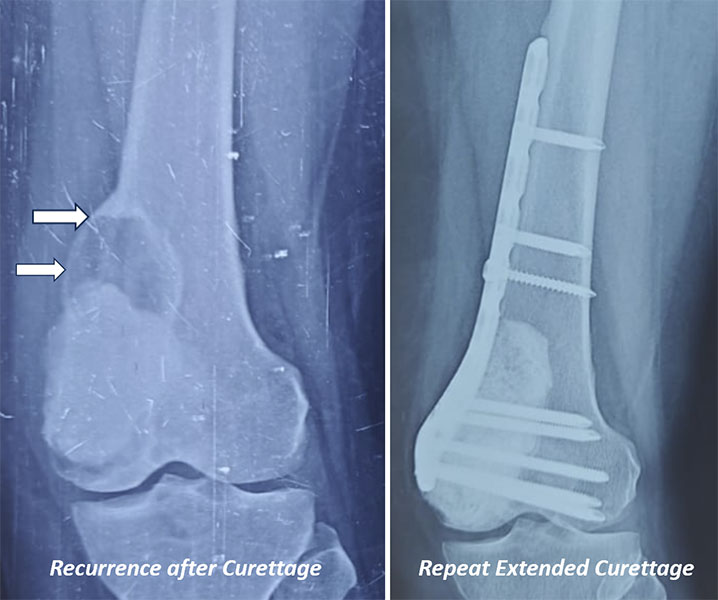
If the recurrence is relatively localized and remains confined within the bone, repeat or re-curettage may be possible.
During re-curettage, the recurrent tumor is removed from within the bone, followed by thorough treatment of the tumor cavity and reconstruction.
Depending on the location and size of the defect, reconstruction may involve:
- Bone cement
- Bone graft or bone substitute
- Internal fixation when required
- Local adjuvant techniques
A systematic review of recurrent GCTB found that intralesional treatment with PMMA cement was associated with lower second-recurrence rates and better functional outcomes than bone grafting in the included studies.
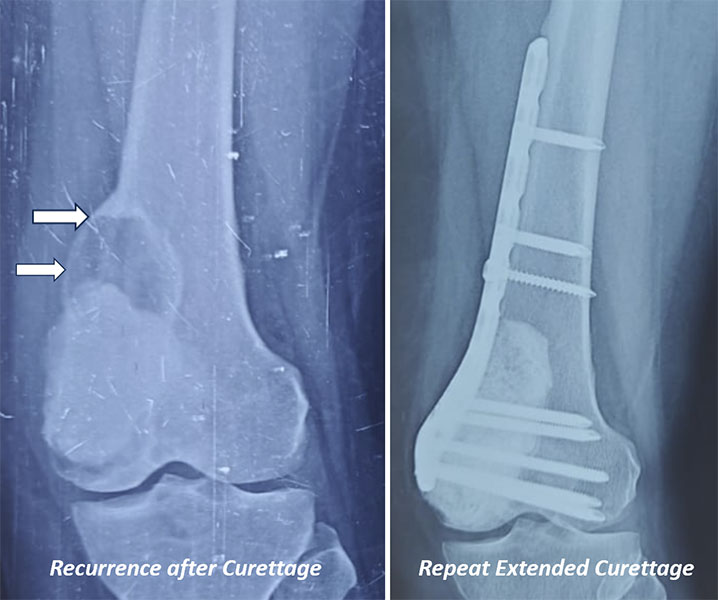
Figure 1. Joint preservation is sometimes possible even when Giant Cell Tumor of Bone recurs. This case demonstrates recurrence after initial curettage followed by repeat extended curettage and reconstruction, allowing preservation of the natural knee joint.
However, re-curettage is not suitable for every recurrence. If the recurrent tumor is extensive or difficult to remove completely, repeating the same procedure may carry an unacceptable risk of another recurrence.
When Is Wide Resection Recommended?
Sometimes recurrence has progressed beyond what can safely be treated with curettage.
Wide resection involves removing the recurrent tumor along with the involved segment of bone.
It may be considered when there is:
- Extensive destruction of the surrounding bone
- Significant soft-tissue extension
- Extensive involvement of the joint
- Repeated local recurrence
- Inability to achieve adequate tumor removal by curettage
- Severe structural damage to the bone
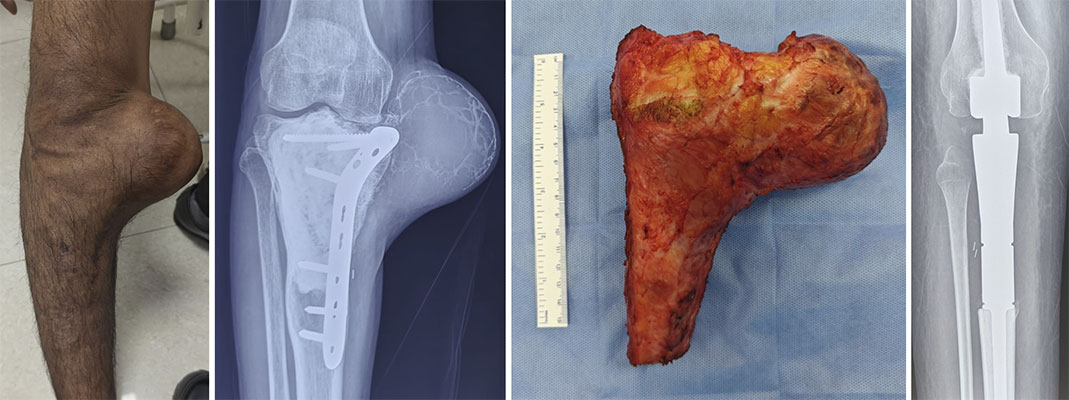
Figure 2. Extensive recurrence may require wide resection and reconstruction. In this case, recurrent Giant Cell Tumor of Bone was treated with removal of the involved bone and reconstruction using a tumor prosthesis.
Wide resection provides more extensive removal of the affected tissue, but it also creates a larger bone defect and may require complex reconstruction.
The decision is therefore based on achieving the right balance between tumor control and preservation of function.
Does Recurrence Always Mean Joint Replacement?
No.
This is one of the most important things patients should understand.
A recurrent GCTB can sometimes be treated while preserving the natural joint, particularly when the recurrence is localized and sufficient healthy bone and joint surface remain.
However, if the recurrence has significantly damaged the joint or the bone supporting the joint, attempting to preserve it may not provide a durable or functional result.
In such circumstances, removal of the involved bone and reconstruction with a tumor prosthesis or another reconstructive procedure may be the better option.
The decision should be based on the actual extent of the recurrent tumor—not simply on the fact that it has recurred.
What If the Recurrence Has Extended Into Soft Tissue?
Soft-tissue extension makes treatment more challenging.
A recurrent tumor that has broken through the bone and formed a soft-tissue component may be difficult to completely remove through curettage alone.
If the soft-tissue component is limited and accessible, it may sometimes be removed along with repeat curettage. However, a large or extensive soft-tissue recurrence may require wide resection and reconstruction.
This is one reason MRI is particularly important when planning treatment for recurrent GCTB.
What If There Is a Pathological Fracture?
A pathological fracture through recurrent GCTB requires careful assessment.
The fracture itself does not automatically mean that the limb or joint must be sacrificed.
The decision depends on:
- Location of the fracture
- Extent of recurrent tumor
- Amount of remaining bone
- Joint involvement
- Soft-tissue extension
- Whether stable reconstruction is possible
In selected situations, repeat curettage with reconstruction and fixation may still be possible. In more extensive disease, wide resection and reconstruction may be necessary.
What Is the Role of Denosumab in Recurrent GCTB?
Denosumab is an important systemic treatment option in selected patients with GCTB.
It may be considered when:
- The recurrent tumor is difficult to operate on
- Surgery would result in major functional loss
- The tumor is in a surgically challenging location
- There is extensive or unresectable disease
- There is metastatic disease in selected patients
Denosumab can reduce pain and produce significant radiological changes in GCTB. It can also sometimes make an otherwise difficult operation more feasible.
However, its use around surgery requires careful consideration.
Several systematic reviews and meta-analyses have reported an association between preoperative denosumab followed by curettage and a higher risk of local recurrence, although the available evidence is observational and affected by the fact that denosumab is often given to patients with more aggressive tumors in the first place.
Therefore, denosumab should not be automatically given simply because a GCTB has recurred. Its role needs to be considered in the context of the surgical options and the individual patient’s disease.
What If the Tumor Comes Back More Than Once?
Repeated recurrence requires particularly careful planning.
A second recurrence may be more difficult to treat because each recurrence can result in further bone destruction and loss of normal anatomy.
At this stage, the treatment may involve:
- Repeat curettage in carefully selected cases
- Wide resection
- Tumor prosthesis or other reconstruction
- Denosumab in selected advanced or unresectable cases
- A combination of surgery and systemic treatment
A systematic review of 458 patients with recurrent GCTB reported a second-recurrence rate of approximately 20.5% after treatment of the first recurrence, with second recurrence more frequently observed after intralesional curettage than after en-bloc resection.
This does not mean that every recurrent tumor requires wide resection. Rather, it highlights why the treatment of recurrence should be individualized and carefully planned.
What About Lung Metastases?
A small proportion of patients with GCTB develop pulmonary metastases, and the risk is particularly relevant in patients with recurrent disease.
If lung nodules are detected, they do not automatically mean that the disease is uncontrollable.
The number, size and growth of the nodules, together with the status of the primary tumor, need to be assessed.
In selected patients with limited pulmonary disease, surgical removal of lung metastases may be considered. Systemic treatment such as denosumab may also have a role in selected situations.
Management is best planned through a multidisciplinary team experienced in GCTB.
Can a Recurrent GCTB Still Have a Good Functional Outcome?
Yes.
The functional outcome depends heavily on where the recurrence is located and how much normal bone and joint can be preserved.
When a recurrence can be adequately treated without sacrificing the joint, preserving the patient’s natural anatomy can offer important functional benefits.
When wide resection is necessary, modern reconstructive techniques—including tumor prostheses, structural grafts and other biological or mechanical reconstructions—can help restore useful limb function.
The aim is therefore not simply to remove the recurrent tumor. It is to achieve durable tumor control while preserving as much function as safely possible.
Summary
A recurrent Giant Cell Tumor of Bone does not automatically mean that you need a joint replacement or that your limb cannot be saved.
If the recurrence is limited and the joint and surrounding structures remain suitable, repeat curettage and reconstruction may be possible.
If the recurrence is extensive, involves the joint, has a large soft-tissue component or has returned repeatedly, wide resection and reconstruction may provide better local control.
Denosumab can be useful in selected advanced or difficult-to-operate cases, but its use around surgery needs careful consideration.
The most important step after a recurrence is therefore not to assume that the same treatment—or the most radical treatment—is automatically required. The recurrent tumor should be reassessed with appropriate imaging and managed according to its individual extent and location.
Why Consult Dr. Love Kapoor for Recurrent Giant Cell Tumor?
Hearing that your Giant Cell Tumor has returned can be particularly stressful, especially if you have already undergone surgery once.
You may be asking:
- Can it be removed again?
- Can I still save my joint?
- Will I need a tumor prosthesis this time?
- Is another curettage possible?
- Do I need denosumab?
These decisions are often more complex than those made at the time of the first diagnosis.
As an AIIMS-trained Orthopaedic Oncologist specializing in bone tumors and soft tissue sarcomas, Dr. Love Kapoor focuses on the surgical and long-term management of musculoskeletal tumors.
When evaluating recurrent GCTB, the aim is to understand exactly where the tumor has returned, how much normal bone and joint remain, whether there is soft-tissue extension, and what treatment will provide the best balance between tumor control and function.
In selected patients, repeat surgery can still preserve the natural joint. In others, a more extensive resection and reconstruction may be the safer option. The treatment decision is made according to the individual recurrence rather than simply the fact that the tumor has returned.
If you have been diagnosed with recurrent GCTB or have been advised a second surgery, a specialist orthopaedic oncology consultation can help you understand whether joint-preserving treatment is still possible, whether a more extensive reconstruction is required, and what options are available for controlling the recurrent tumor.
Medical Disclaimer: This article is intended for general educational purposes and does not replace an individual medical consultation. Treatment of recurrent GCTB depends on the location and extent of recurrence, previous treatment, imaging, pathology and the patient’s overall clinical situation.
Category:
Giant Cell Tumor of Bone
Tags:
Recurrent Bone Tumor
Recurrent GCTB
Repeat Curettage
Wide Resection
 +91 93558 33005